What is the refrigerant circuit design in carrier chillers?
Leave a message

As a trusted supplier of Carrier chillers, I've had the privilege of delving deep into the intricacies of these remarkable cooling systems. One of the most critical aspects that sets Carrier chillers apart is their refrigerant circuit design. In this blog, I'll take you on a journey through the refrigerant circuit design in Carrier chillers, exploring its components, functions, and the benefits it offers.
Understanding the Basics of a Refrigerant Circuit
Before we dive into the specifics of Carrier chillers, let's first understand the fundamental principles of a refrigerant circuit. At its core, a refrigerant circuit is a closed-loop system that transfers heat from one location to another using a refrigerant, a substance with excellent heat transfer properties. The basic components of a refrigerant circuit include a compressor, a condenser, an expansion device, and an evaporator.
The process begins with the compressor, which compresses the low-pressure, low-temperature refrigerant vapor into a high-pressure, high-temperature vapor. This high-pressure vapor then flows into the condenser, where it releases heat to the surrounding environment (usually through air or water cooling) and condenses into a high-pressure liquid.
Next, the high-pressure liquid refrigerant passes through an expansion device, which reduces its pressure and temperature. This low-pressure, low-temperature liquid then enters the evaporator, where it absorbs heat from the space or process being cooled, evaporating back into a low-pressure vapor. The cycle then repeats as the low-pressure vapor returns to the compressor.
Refrigerant Circuit Design in Carrier Chillers
Carrier chillers are renowned for their innovative and efficient refrigerant circuit designs. These designs are tailored to meet the diverse needs of various applications, from commercial buildings to industrial processes. Let's take a closer look at some of the key features and components of the refrigerant circuit design in Carrier chillers.
Compressors
Carrier uses a variety of compressors in its chillers, including centrifugal, screw, and scroll compressors. Each type of compressor has its own advantages and is selected based on the specific requirements of the application.
Centrifugal compressors are known for their high efficiency and capacity, making them ideal for large-scale commercial and industrial applications. They work by using a rotating impeller to accelerate the refrigerant vapor, increasing its pressure.
Screw compressors are another popular choice, offering a good balance between efficiency and capacity. They use two intermeshing screws to compress the refrigerant vapor, providing smooth and reliable operation.
Scroll compressors are typically used in smaller capacity chillers. They are compact, quiet, and have a simple design, making them suitable for applications where space and noise are concerns.
Condensers
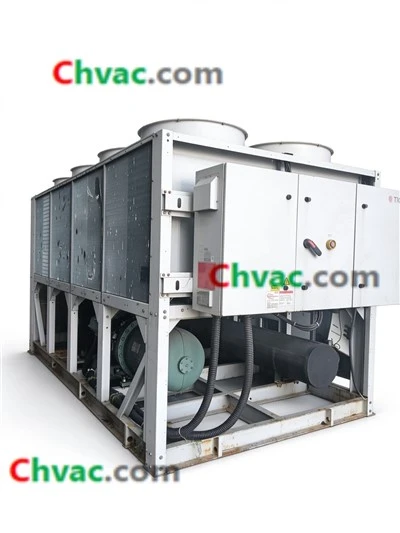
Carrier chillers are available with both air-cooled and water-cooled condensers. Air-cooled condensers use fans to blow air over the condenser coils, dissipating heat to the surrounding air. They are easy to install and require less maintenance, making them a popular choice for smaller applications or where water availability is limited.
Water-cooled condensers, on the other hand, use water to remove heat from the refrigerant. They are more efficient than air-cooled condensers, especially in hot climates, and can handle larger cooling loads. Carrier offers a range of water-cooled condensers, including shell-and-tube and plate heat exchangers, to meet the specific needs of different applications.
Expansion Devices
The expansion device in a Carrier chiller plays a crucial role in controlling the flow and pressure of the refrigerant. Carrier uses a variety of expansion devices, including thermostatic expansion valves (TXVs), electronic expansion valves (EEVs), and fixed orifices.
TXVs are mechanical devices that use a sensing bulb to measure the temperature of the refrigerant vapor leaving the evaporator. Based on this temperature, the valve adjusts the flow of refrigerant into the evaporator to maintain a constant superheat.
EEVs are more advanced and offer greater control and precision. They use electronic sensors and a microprocessor to adjust the refrigerant flow based on various parameters, such as temperature, pressure, and load.


Fixed orifices are simple and inexpensive expansion devices that provide a fixed flow of refrigerant. They are typically used in smaller capacity chillers or applications where precise control is not required.
Evaporators
The evaporator in a Carrier chiller is responsible for absorbing heat from the space or process being cooled. Carrier offers a variety of evaporator designs, including direct expansion (DX) evaporators and flooded evaporators.
DX evaporators are the most common type and are used in most Carrier chillers. In a DX evaporator, the refrigerant evaporates directly inside the evaporator coils, absorbing heat from the air or water passing over the coils.
Flooded evaporators are typically used in larger capacity chillers or applications where a high heat transfer rate is required. In a flooded evaporator, the evaporator tubes are completely submerged in liquid refrigerant, providing a large surface area for heat transfer.
Benefits of Carrier Chiller Refrigerant Circuit Design
The innovative refrigerant circuit design in Carrier chillers offers several benefits, including:
Energy Efficiency
Carrier's advanced compressor and expansion device technologies, combined with efficient condenser and evaporator designs, result in high energy efficiency. This means lower energy consumption and reduced operating costs for the end-user.
Reliability and Durability
Carrier chillers are built to last, with high-quality components and robust construction. The refrigerant circuit design is optimized for reliable operation, minimizing the risk of breakdowns and downtime.
Flexibility and Customization
Carrier offers a wide range of chiller models and configurations to meet the specific needs of different applications. The refrigerant circuit design can be customized to accommodate various refrigerants, cooling capacities, and operating conditions.
Environmental Sustainability
Carrier is committed to environmental sustainability and uses refrigerants with low global warming potential (GWP) in its chillers. The efficient refrigerant circuit design also helps to reduce greenhouse gas emissions by minimizing energy consumption.
Examples of Carrier Chillers with Advanced Refrigerant Circuit Design
To illustrate the benefits of Carrier's refrigerant circuit design, let's take a look at some specific models:
- Carrier 30XW0612 Water Cooled Chiller: This chiller features a centrifugal compressor and a water-cooled condenser, providing high efficiency and reliability for large commercial and industrial applications.
- Carrier 19XR8R84E63MFB52 Water Cooled Chiller: With its advanced screw compressor technology and water-cooled condenser, this chiller offers excellent energy efficiency and performance.
- Carrier 30XW Chiller: The Carrier 30XW chiller series is known for its innovative refrigerant circuit design, which includes a variety of compressor options and efficient heat exchangers.
Contact Us for Carrier Chiller Procurement
If you're interested in learning more about Carrier chillers and their refrigerant circuit design, or if you're looking to purchase a Carrier chiller for your application, we'd love to hear from you. As a leading supplier of Carrier chillers, we have the expertise and experience to help you select the right chiller for your needs and provide you with comprehensive support throughout the procurement process.
Contact us today to start a conversation about your cooling requirements and explore the possibilities of Carrier chiller technology.
References
- Carrier Corporation. (n.d.). Carrier Chiller Product Catalog.
- ASHRAE Handbook - Refrigeration. (2020). American Society of Heating, Refrigerating and Air-Conditioning Engineers.